
Over the past few weeks, I have come across various articles exploring the role of adult education in a democratic society. They have also made me reflect on our work at TRANSIT. For I do occasionally wonder just how relevant our topics and questions actually are to those involved in adult education. Particularly with regard to our current focus topic, ‘polarisation’, many adult education providers may not see this as an immediately pressing issue for the future of to their work.
Just recently, the European Association for the Education of Adults (EAEA) and the Irish adult education organisation AONTAS published a joint statement on the role of adult learning in fostering a resilient, democratic and competitive Europe. In it, they argue that adult education achieves far more than simply imparting competencies relevant to the labour market. It enables democratic participation, strengthens critical thinking and media literacy, and can help to build trust and social resilience. Community-based educational programmes are of particular importance in this regard, as they also reach people who find it difficult to access formal education.
From a slightly different perspective, but with similar arguments, the Swedish scholar Magnus Dahlstedt speaks in an interview in ELM Magazine. He describes the significance of Swedish ‘folkbildning’: community-based, self-determined forms of adult learning that are guided by people’s experiences and needs. Dahlstedt speaks of a diverse ecosystem of community-based learning, a «powerful vehicle for democracy, inclusion and social progress». Such learning spaces create opportunities for people to come together, learn together and engage in critical debate. He sees them as increasingly under threat, partly due to education policies that primarily gear adult education towards predefined competencies and labour market requirements. What is lost in the process are educational opportunities that also serve as spaces for social understanding and democratic participation.
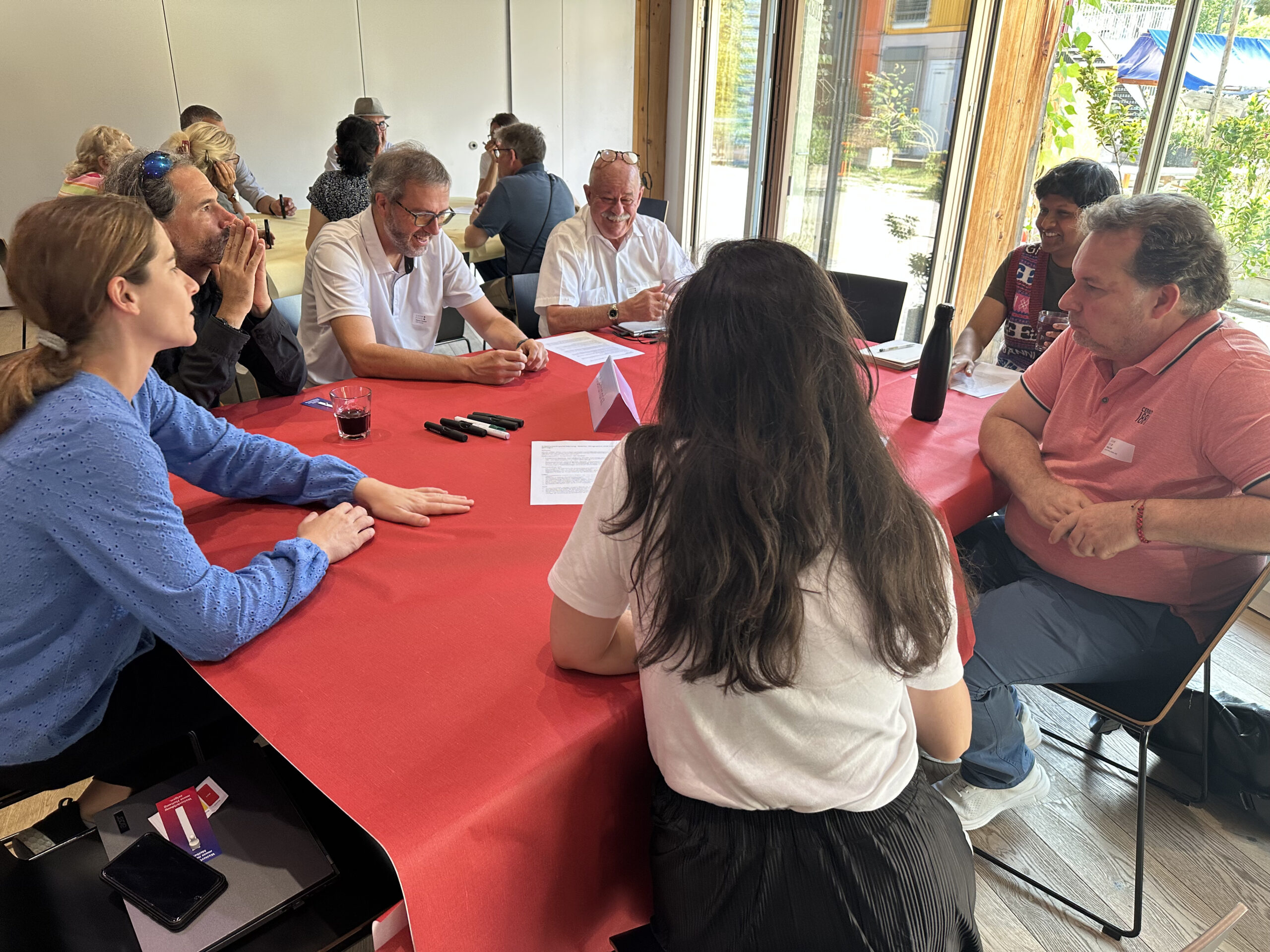
Both contributions reminded me of the discussions at our TRANIST event on polarisation in September. Isabel Schuler from Pro Futuris spoke there of the ‘democracy muscle’ that a society must continually exercise. This requires spaces for interaction, a change of perspective and the experience that controversial discussions are possible without breaking down immediately. I heard similar thoughts from the participants. This wasn’t just about educational programmes on democracy or political opinion-forming, but also about informal encounters – such as during coffee breaks – and learning environments where people with different experiences and beliefs actually engage in conversation with one another.
At the same time, an ambivalence became apparent at the event that has been on my mind. Adult education does not automatically foster encounters that transcend social boundaries. Target-group-specific programmes, varying entry requirements and the social selectivity of adult education can just as easily lead to people remaining predominantly amongst their peers. We therefore also discussed whether adult education sometimes tends to reinforce existing social ‘bubbles’ rather than breaking them down.
This strikes me as an important question, particularly in light of social and affective polarisation. The fact that people hold different political views and engage in heated debate is part and parcel of democracy. It becomes problematic, however, when social worlds drift apart, points of contact are lost, and political differences are increasingly accompanied by mistrust and mutual disparagement. Adult education cannot simply reverse such developments. And it would be presumptuous to declare adult education the solution to societal problems. But it can help ensure that people remain in dialogue with one another despite their differing experiences and convictions.
What interests me about these various discussions is the idea of adult education as part of a social and democratic infrastructure. It shifts the focus beyond individual educational programmes and their immediate benefits to the question of what role adult learning plays in social cohesion. This also opens up a perspective on the future of adult education that is not based exclusively on the current challenges faced by providers.
However, the question remains as to how we can reconcile this societal aspiration with the reality of the adult education system. For many adult education providers in Switzerland, the pressing challenges understandably lie elsewhere: in funding, demand, digitalisation or quality. Does it therefore make sense for us at TRANSIT to address the issue of polarisation? After all, a socially relevant problem is not automatically a question concerning the future of adult education.
On the other hand, the societal relevance of an issue can hardly be measured solely by whether it is already perceived within the adult education system as a concrete need for action. It seems important to me that a think tank such as TRANSIT should be able to take societal developments as the starting point for its deliberations, even if their significance for adult education is not yet clear.
However, this position is not entirely straightforward. Who actually determines which societal developments are particularly relevant to adult education? And how do we prevent ourselves from hastily deriving an educational mandate from a diagnosis of a societal problem? A think tank needs a certain critical distance from existing institutions and their immediate interests. At the same time, it relies on the knowledge, experience and involvement of those active in the field of continuing education. Without this connection, future societal prospects risk remaining abstract and detached from practical reality.
In any case, the current European debates and the discussions at our TRANSIT event reinforce my belief that it is worth taking a closer look at the social role of adult education. We should therefore not only consider the future of adult education in terms of the challenges facing the existing system, but also in terms of the question of what sort of adult education a society will need in the future.