
Future skills are regarded as a key prerequisite for coping with social change. At the same time, it often remains unclear exactly what is meant by this and how they can be specifically promoted in adult learning and education.
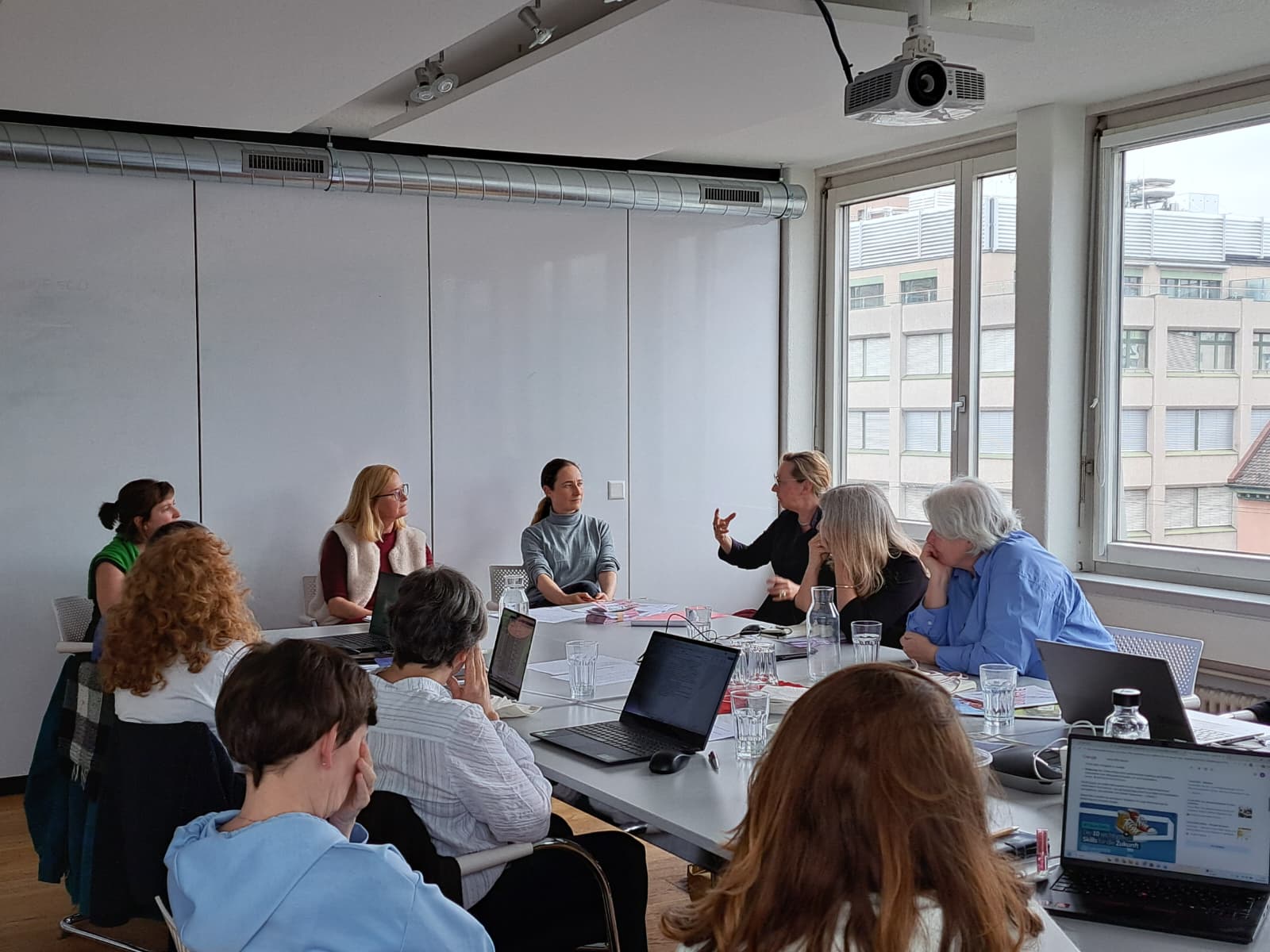
Against this backdrop, the topic of « Future Skills » also took centre stage at the DACH Exchange in March 2026 in Zurich.
Representatives from the German Institute for Adult Education (DIE), the Austrian Academy for Continuing Education (wba) and the swiss federation for adult learning (SVEB) discussed, on the basis of recent studies, the role Future Skills play in the professionalisation of adult learning and education and how they can be defined in both conceptual and practical terms.The workshop took as its starting point two recent studies: the TRANSIT Trend Report on Future Skills and the Future of Continuing Education, and the DIE study on Future Skills in Adult Education.
The TRANSIT Trend Report analyses future skills from a systemic perspective and demonstrates that future skills should be understood not so much as fixed lists of competencies, but rather as dynamic and context-dependent abilities for dealing with uncertainty, complexity and change. Particular focus is placed on the role of adult learning and education as a driving force in social change.
The DIE study is based on a survey of adult learning and education practice and highlights which future skills are currently considered relevant and are actually being implemented. Among other things, it shows that future skills often already play a role in practice, but frequently remain implicit and are rarely systematically identified or reflected upon in a didactic manner.
The perspectives of the two studies complement each other well. Whilst TRANSIT takes a more conceptual and future-oriented approach, the DIE contributes empirical insights from practical implementation. These complementary perspectives formed an ideal basis for the workshop, which focused on three key areas of tension in which future skills operate.
Area of tension 1: Is ‘Future Skills’ a helpful new approach or just a new label for well-known key competences?
The discussion made it clear that many do not view ‘Future Skills’ as an entirely new concept, but rather as a reframing of the concept of key competences. The term can help to revitalise the debate and focus it more strongly on current societal challenges.
Given its societal focus, the discussion then turned to responsibilities. The participants agreed that it is not just about the individual and their personal development, but about a systemic perspective and the societal contribution of Future Skills.
Possible answer: ‘Future Skills’ are not an entirely new concept; they broaden the focus from individual skills development to social responsibility for the future.
Area of tension 2: Do we need competence models and lists of relevant future skills for guidance, or is an open exploration of possible futures more useful for dealing with an uncertain future?
A key finding was that the contrast between competence models and open reflection on the future falls short. It is not a question of ‘either/or’, but of ‘both/and’. Engaging with possible futures helps to identify relevant competence needs; competence models make these tangible and support their translation into concrete action.
It was also emphasised that the future must always be considered in the interplay of past, present and future. For the past forms the basis of our respective (mostly implicit) assumptions on which our visions of the future rest. And we must start in the present if we want to do something for the future. A comparison with therapeutic approaches was used as an illustrative example: reflection on the future as an understanding-based approach (psychoanalysis), competence models as an action-oriented approach (behavioural therapy).
Possible answer: Future skills need both: open discussions about the future for orientation and competence models for implementation in the present.
Area of tension 3: Does the promotion of future skills require dedicated learning formats (courses), or is it primarily a matter of making them visible within existing learning processes?
The third area of focus centred on the question of how future skills can be promoted in practical terms. The discussion made it clear that several interlinked steps are essential: first, it is necessary to clarify which future skills are relevant in the specific context. Building on this, these skills must be made explicit within the learning process. This enables learners to recognise and identify their own skills development, and to demonstrate it to others.
Equally important is the subjective experience: future skills remain abstract if they cannot be experienced in concrete situations. They only reveal their significance in interaction with other skills and within the individual’s specific context of application.
Possible answer: Dedicated learning formats for future skills are possible. However, it is above all important to make them visible within existing learning processes and to give them subjective meaning in combination with other skills.
Conclusion
The discussions in the workshop made it clear that future skills are not a clearly defined concept, but rather operate within various areas of tension: between the familiar and the new, between openness and structure, and between different didactic approaches.
It is precisely these areas of tension that open up productive spaces for thought and implementation. Future skills can thus serve as an opportunity to rethink and further develop the role of adult learning and education in a changing society.
References
Helen Buchs (2025): TRANSIT – Fourth Trend Report 2025: Future Skills and the Future of Adult Learning.
Brigitte Bosche & Mona Pielorz (2025): Future Skills in Continuing Education. Results of a survey in collaboration with the DIALOG Practice Network for Knowledge Transfer and Innovation. DOI: 10.58000/vq6x-a235